How do you interpret scripture? Theologians point out that we all begin from a particular point of view, a theological location. Often they will refer to the “lens” we use to view the text. John Calvin used the image of “spectacles”.
Sometimes we like to tell ourselves we don’t interpret, we simply read what the text says. That “neutral” reading is in itself is a particular “lens”. We read the Bible as the person we are and we bring ourselves to the text. Each of us is a person living in a particular time and place with our own experiences and ideas. We also bring our culture, race, gender, and all the other things that shape and influence who we are. Often we don’t notice the lens we read through, because it’s just how we read and interact with the world.
I bring all this up to remind us that we, often by default, read the Bible through the lens of hierarchy and power. Usually this hierarchy and power framing is God->rulers or church authorities->the rest of us. Sometimes the hierarchy and power lens continues through the rest of us, men-> women->children. Hierarchies are about who is in charge; who has power and authority and control over others.
Jesus’ instructions about how to interact with a person who “sins against you” is often interpreted through the lenses of hierarchy, control, and power. This text has been used as the template for when and how to disfellowship or excommunicate others. We may read it as instructions for church discipline. But what if we use a different lens, a different set of spectacles?1
“If your brother and sister sins against you, go and point out the fault when the two of you are alone. If you are listened to, you have regained that one. But if you are not listened to, take one or two others along with you, so that every word may be confirmed by the evidence of two or three witnesses. If that person refuses to listen to them, tell it to the church, and if the offender refuses to listen even to the church, let such a one be to you as a gentile and a tax collector. Truly I tell you, whatever you bind on earth will be bound in heaven, and whatever you loose on earth will be loosed in heaven. Again, truly I tell you, if two of you agree on earth about anything you ask, it will be done for you by my Father in heaven. For where two or three are gathered in my name, I am there among them.” Matthew 18:15-20 NRSVue
These verses are part of the fourth discourse in the Gospel of Matthew, where Jesus speaks about our distinctive, shared life as his followers.2 He speaks about how we should treat each other. Just before these verses, Jesus tells the parable of the shepherd who searches for the lost sheep.3 And just before that, he warns against being a stumbling block to others. 4 Just after verses 15-20 Peter asks a question, “Lord, if another member of the church sins against me, how often should I forgive? As many as seven times seven?” Jesus replies, “Not seven times, but, I tell you, seventy-seven times.”5
Given that this teaching about “church discipline” is bracketed by texts about being careful and intentional about our own behavior and expansive forgiveness, is it really about discipline? Context matters and can often shift our interpretive lens.
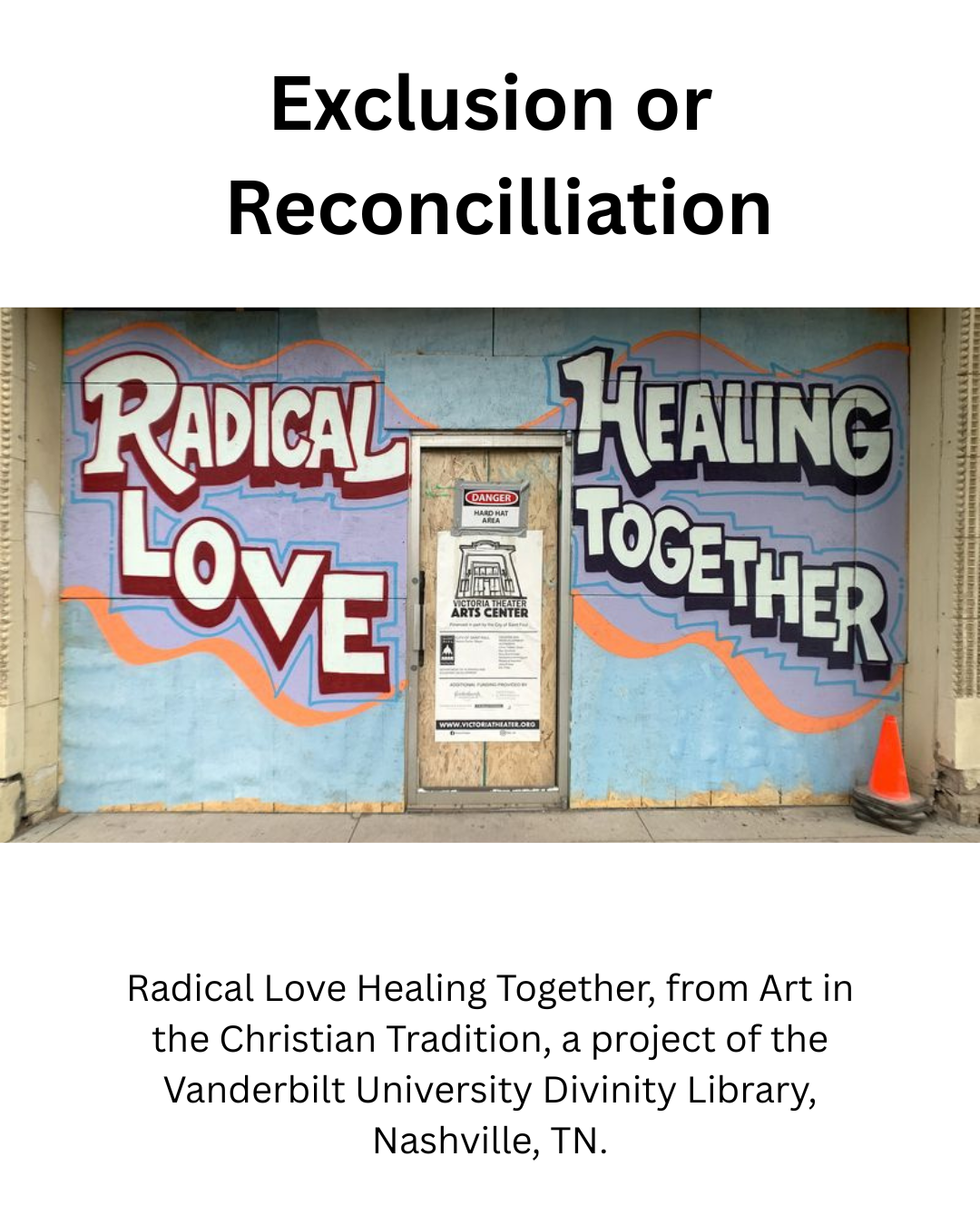
When we think about these verses in the context of generous, caring relationships and expansive forgiveness, what we see is a blueprint for reconciliation, not expulsion. Jesus tells us to make repeated efforts to invite people into the process of reconciliation. If we need help to do it, we should ask the community to support us. It is not a checklist we go through so we can exclude people with a clear conscience. It is not simple, easy or foolproof. It is how we are to live, because we are people who strive for reconciliation.
Sometimes in spite of our best efforts, reconciliation is not possible. Some behaviors and actions cannot be endlessly endured or tolerated. Some behaviors and actions are harmful and need to end- either by a person behaving better or by their absence. Then Jesus tells us “let such a one be to you as a gentile and a tax collector.” I have a friend who says, “All people are welcome, but not all behaviors are welcome.” I think that’s what Jesus means here.
We need to remember that Jesus seems to have spent plenty of time with sinners, gentiles and tax collectors. Jesus welcomed them into fellowship. Their status as outsiders was not their final state. Exclusion is not permanent. The invitation to reconciliation remains open.
At the same time, we may need to set boundaries- as an individual or a community. Not every act of forgiveness results in reconciliation. Some wounds are too deep. Some situations are unsafe. At the same time, there is a welcome place for everyone somewhere in the Church universal. However no single community can be the best place for everyone. We as individuals and communities need to be prayerfully wise.
Historically and in our current time, some want to take Jesus’ teaching about reconciliation and twist it into a divinely sanctioned warrant to decide who has sinned and who to exclude. In this hierarchical view, a very few have the power to decide who belongs, who is part of the community.
Christian Nationalism6 takes this a step farther and wants to decide who belongs in the nation. Or who votes. Or who has civil rights. Or access to health care, or education. Or access to goods and services. Rather than following Jesus’ example of ever widening inclusion, some divide the world into those on the inside and those on the outside.
The lens we use to read the Bible and to discern the way of Jesus matters. We live in a culture that prioritizes power and authority. Sometimes it is reasonably innocuous, levels of membership or swag for a donation to a good cause. But if we divide the world into winners and losers, sinners and the redeemed, the included and the excluded, we have wandered away from the path of Jesus. And we will cause tremendous damage to people that Jesus loves.
Today’s passage ends with these words of Jesus, Truly I tell you, whatever you bind on earth will be bound in heaven, and whatever you loose on earth will be loosed in heaven. Again, truly I tell you, if two of you agree on earth about anything you ask, it will be done for you by my Father in heaven. For where two or three are gathered in my name, I am there among them.”
Jesus doesn’t mean that we facilitate or block someone’s presence in heaven or their salvation. Those actions belong to God. Most scholars think the language of “binding and loosing” has to do with teaching.7 If two agree, we know that God doesn’t automatically grant our request. These are reductionist readings. If this…then that.
I do think Jesus is telling disciples then and now, that what we do matters. How we treat each other matters. Actions have consequences, intended and unintended.
We need to treat each other with care.
Jesus teaches inclusion not exclusion; liberation not oppression. If we read his words through the lens of power and hierarchy, we run the risk of misunderstanding and misusing his teaching. If we follow his example of inclusion and liberation and reconciliation, the world will change.
- This text is part of the lectionary, which means I have written about it before, https://conversationinfaith.com/2023/09/08/treat-them-like-gentiles-and-tax-collectors-revisited/ and https://conversationinfaith.com/2011/02/25/treat-them-like-gentiles-and-tax-collectors/ ↩︎
- Matthew collects many of Jesus’ teaching into five discourses, Ch 5-7 the Sermon on the Mount, Ch 10 Mission, Ch 13 Parables, Ch 18 Community relationships and practices, and Ch 24-25 God’s coming empire. ↩︎
- Matthew 18:12-14 ↩︎
- Matthew 18:6-11 ↩︎
- Matthew 18:21-22 ↩︎
- There are varieties of Christian Nationalism. Sometimes, people simply haven’t been encourages to think theologically about the relationship between faith and citizenship. But there is a more dangerous form that wants to create a theocracy and they use hierarchy to impose power and control over others. ↩︎
- See, https://conversationinfaith.com/2026/08/29/get-behind-jesus/ and https://conversationinfaith.com/2017/09/04/alt-empire/ and https://conversationinfaith.com/2011/05/09/forgiveness-2/ ↩︎


Leave a comment