Sometimes Jesus said weird stuff. Sometimes what he said seems weird to us because we don’t understand the context and the culture. Sometimes, he just said weird stuff. The parable of the wise and foolish bridesmaids is a strange parable, weird even. Typically, parables are grounded in the practices or customs of Jesus’ day. While we don’t know everything about first century wedding practices, we do know some things. What we know leads us to think this is a strange parable.
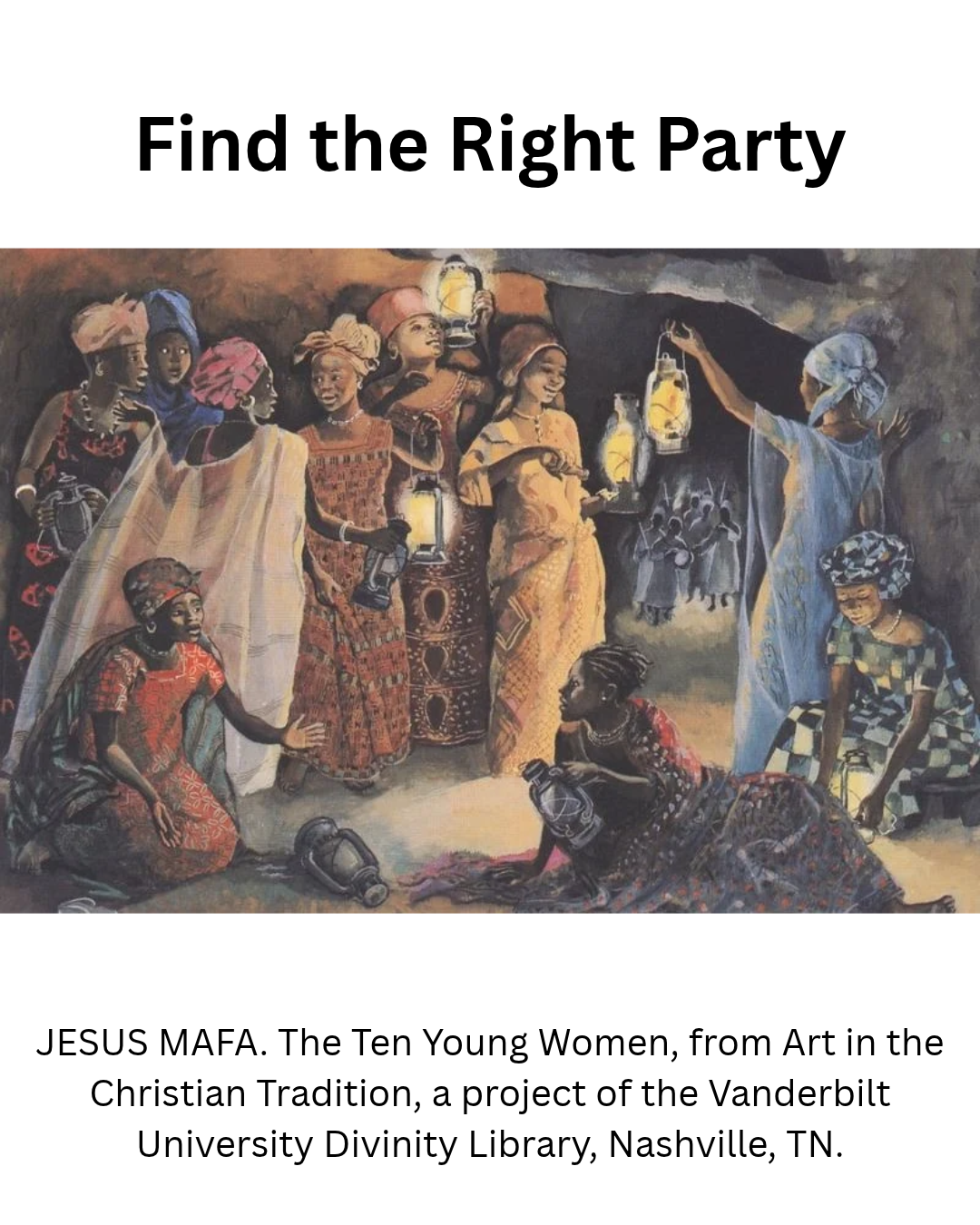
“Then the kingdom of heaven will be like this. Ten young women took their lamps and went to meet the bridegroom. Five of them were foolish, and five were wise. When the foolish took their lamps, they took no oil with them, but the wise took flasks of oil with their lamps. As the bridegroom was delayed, all of them became drowsy and slept. But at midnight there was a shout, ‘Look! Here is the bridegroom! Come out to meet him.’ Then all those young women got up and trimmed their lamps. The foolish said to the wise, ‘Give us some of your oil, for our lamps are going out.’ But the wise replied, ‘No! there will not be enough for you and for us; you had better go to the dealers and buy some for yourselves.’ And while they went to buy it, the bridegroom came, and those who were ready went with him into the wedding banquet, and the door was shut. Later the other young women came also, saying, ‘Lord, lord, open to us.’ But he replied, ‘Truly I tell you, I do not know you.’ Keep awake, therefore, for you know neither the day nor the hour. Matthew 25:1-13 NRSVue
This text, in Mathew’s gospel, is part of a series of sayings and parables about the coming judgment, how no one can know when Jesus will return, and the need to be faithful.1 Bible scholars have traditionally interpreted the bridegroom to be Jesus and that this parable means believers should always be prepared for his return.
At the same time, biblical scholars and teachers have had to ignore or excuse some of the odd features of the story. For example, one takes a lamp with them because they intend to use it. And so why would you take a lamp without oil? Where is the bride and the rest of the wedding party? Why does the bridegroom show up at midnight? Why do the “wise” bridesmaids not share their oil? Where do the “foolish” ones go to buy oil at midnight? Why does the bridegroom refuse entry to the “foolish” bridesmaids? Aren’t they invited guests? How does he not know them?
We might expect that Jesus’ audience may have had similar questions. This was a very strange wedding banquet.
But what if the bridegroom isn’t Jesus?2 Our default reading of parables is to think that the main male character is either God or Jesus. The bridegroom. The landowner. The king. But this can lead to some convoluted interpretations and sometimes a theological conclusion that is at odds with the rest of the gospels.
In Matthew’s gospel, we are still in Holy Week where Jesus has been engaged in a series of discussions with the religious elite about authority and faithfulness. Throughout the entire gospel, Jesus has been talking about the coming reign of God and what it looks like. He has been talking about how the political and religious power brokers and systems shut people out. He has presented the kingdom of God as a place of inclusion and welcome. The kingdom of God is a place where people are invited in rather than shut out.
Let’s re read this parable and look at it differently. What if the bridegroom was the leader or the rich person, who did what they wanted, when they wanted, regardless of how it impacted others? What if the “wise” bridesmaids ascribed to the scarcity model of society. There is not enough for everyone. They have what they need. Perhaps they think this means God has particularly blessed them. Everyone else needs to take care of themselves. Why would they, who have, share with those who do not have?
In the parable, to participate in the wedding meant one had to to buy what was needed. The prepared were favored and welcomed. Those who were unprepared were excluded. They had been invited, but it turned out the invitation was conditional. The wedding banquet they missed was closed, and exclusionary. Evidently the bride is still not present.
Where does this leave us? Perhaps the closed wedding banquet was not the real kingdom feast. What if the ones behind the locked door, who think they are the invited few, have gone to the wrong banquet? What if the banquet will be someplace else entirely? What if all sorts of people, the prepared and the unprepared are invited? What if there are no locked doors at the true wedding banquet.
What if the “foolish” bridesmaids, locked out of one banquet, then keep looking for the real banquet? What if the only thing they missed out on was a bad party that was a meager imitation of the actual banquet.
The message of the parable may be that we should be on the lookout for the real banquet. Don’t accept a shallow substitution. The message may also be don’t assume you know exactly when, and where, and who will be at the heavenly banquet. You, along with the rest of us, will be surprised. It will be a feast beyond our imaginations. Don’t settle for less. Don’t go to the wrong party.
- This parable is part of what is called “The Judgment Discourse”, chapters 23-25. It contains warnings and parables about the coming judgment and the need to live lives focused on the kingdom of God. ↩︎
- This post is based on the work of Diana Butler Bass, A Beautiful Year, St.Martin’s Essentials, 2025, pages 247-251; and Amy Jill Levine, Short Stories By Jesus, HarperOne, 2014, p302-303, ….???? I am also influenced by N.T. Wright’s work which challenges the idea that the main character in any given parable is God or Jesus. ↩︎


Leave a Reply