You remember the Parable of the Rich Get Richer? Perhaps you know it as the Parable of the First Remain On Top? No? Does the Parable of the guy with an excessive amount of money ring a bell?1
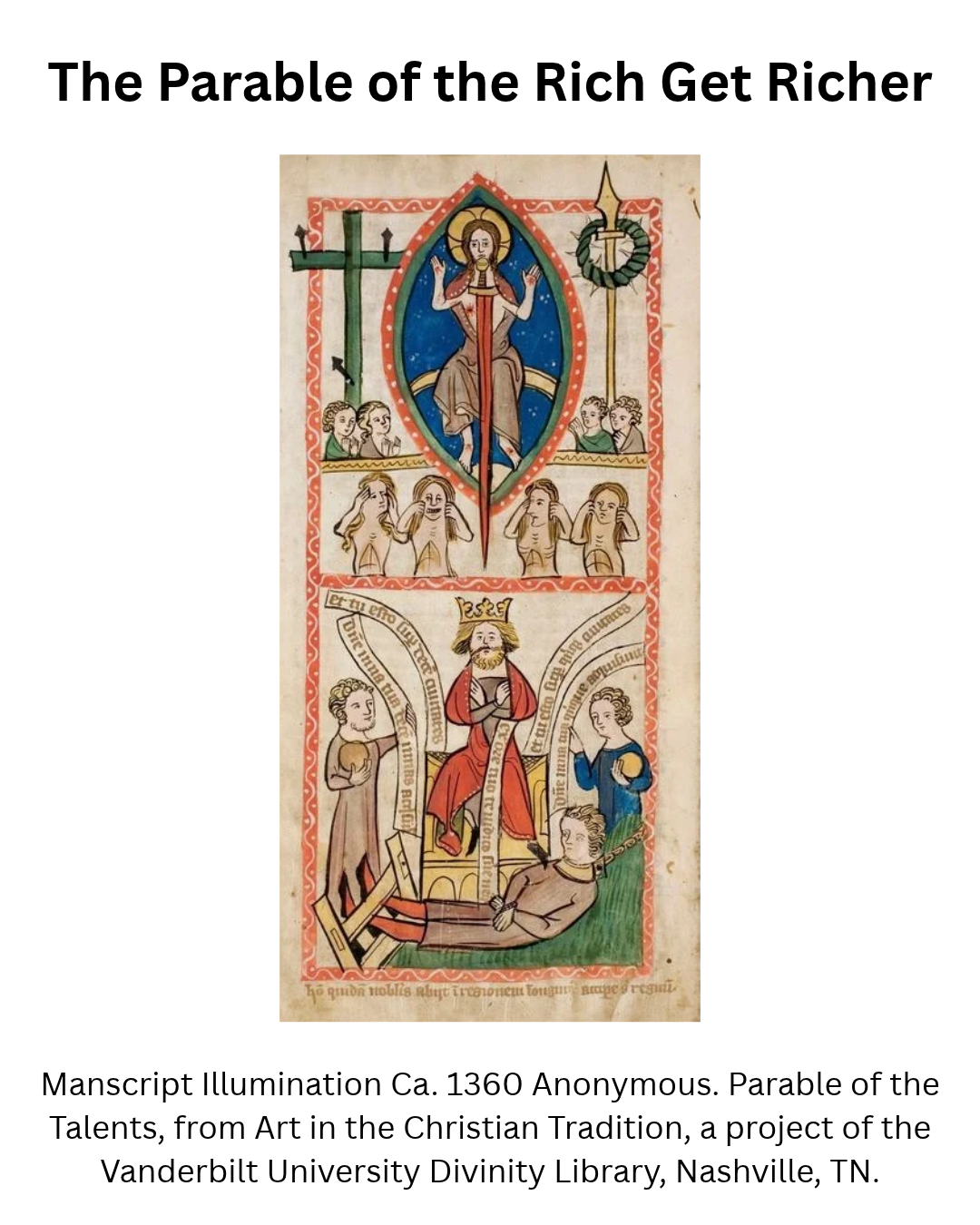
This parable, typically named, the parable of the talents, is another parable Jesus tells during Holy Week. In Matthew’s gospel this parable comes right after the Parable of the Wise and Foolish Bridesmaids2. Commonly this parable’s meaning is assumed to be that we should use our “talents” for God.3 As with many other parables, our default reading is to assume the man or the master or the king in the parable is either God or Jesus. But what if it isn’t? Can we suspend our assumptions about what the parable “means” and read it to see what we discover?
“For it is as if a man, going on a journey, summoned his slaves and entrusted his property to them; to one he gave five talents, to another two, to another one, to each according to his ability. Then he went away. At once the one who had received the five talents went off and traded with them, and made five more talents. In the same way, the one who had the two talents made two more talents. But the one who had received the one talent went off and dug a hole in the ground and hid his master’s money. After a long time the master of those slaves came and settled accounts with them. Then the one who had received the five talents came forward, bringing five more talents, saying, ‘Master, you handed over to me five talents; see, I have made five more talents.’ His master said to him, ‘Well done, good and trustworthy slave; you have been trustworthy in a few things; I will put you in charge of many things; enter into the joy of your master.’ And the one with the two talents also came forward, saying, ‘Master, you handed over to me two talents; see, I have made two more talents.’ His master said to him, ‘Well done, good and trustworthy slave; you have been trustworthy in a few things; I will put you in charge of many things; enter into the joy of your master.’
Then the one who had received the one talent also came forward, saying, ‘Master, I knew that you were a harsh man, reaping where you did not sow and gathering where you did not scatter, so I was afraid, and I went and hid your talent in the ground. Here you have what is yours.’ But his master replied, ‘You wicked and lazy slave! You knew, did you, that I reap where I did not sow and gather where I did not scatter? Then you ought to have invested my money with the bankers, and on my return I would have received what was my own with interest. So take the talent from him, and give it to the one with the ten talents. For to all those who have, more will be given, and they will have an abundance, but from those who have nothing, even what they have will be taken away. As for this worthless slave, throw him into the outer darkness, where there will be weeping and gnashing of teeth.’” Matthew 25:13-30 NRSVue
A talent, in our useage, usually doesn’t mean money. Typically it means skills or abilities. In Jesus’ time, a “talent” was “a large unit of money equal to 6,000 drachmae or denarii. A drachmae was about a day’s wage for a worker. Thus, 1 talent was roughly equal to what a typical worker would make over a sixteen-year period.”4
Our tendency is to read this parable with the modern definition in mind. In that case we might interpret the parable to mean we should use our skills and abilities (and also money) for God. But for the original audience, this parable was about money and wealth.
The parable’s common interpretation, using our gifts for God, works until one of the slaves points out that the master was harsh and took what was not his. The master was someone to be afraid of and so the slave made sure he didn’t risk losing the masters money.
The master responds that the slave was exactly right in his assessment of the master. He then, takes away the talent, calls the slave worthless and throws him out.
This is where, for Jesus’ audience, for Matthew’s audience, and for us the parable becomes disturbing. The master doesn’t sound much like Jesus. Particularly when the master affirms how the world worked than and works now, those who have will get more, and those who have nothing will lose the little they have.
But Jesus is known for saying just the opposite. “[T]he last will be first and the first last”.5And “Do not store up for yourselves treasures on earth, where moths and vermin destroy, and where thieves break in and steal. But store up for yourselves treasures in heaven, where moths and vermin do not destroy, and where thieves do not break in and steal. For where your treasure is, there your heart will be also”.6 And “Truly I tell you, it will be hard for a rich person to enter the kingdom of heaven. 7
We could go on, but you get the message. Jesus never talks about accumulating money, even for God. Jesus teaching is focused on what we do for others, which turns out is what God wants from us.
The master was extremely wealthy. The ESV Bible notes estimates one talent would be worth $600,000 US dollars.8 That means 16 talents is roughly $ 9,600,000. That is 256 years worth of a worker’s annual salary. While it’s hard to know exactly how much a talent would be in current US dollars, but whatever source you use, it’s a lot of money. Having $9,600,000 to invest, not live on, but available to invest, means he was extremely wealthy.
What about the slave who hides the money? We don’t know, but parables invite us into curiosity and into wonder. Not all of us have the fortitude to make the kind of investments that doubles our money. Those sorts of investments are risky. Perhaps the third slave simply isn’t a risk taker. One or two more talents really wouldn’t affect the wealth of the master. But losing the master’s money would have consequences. At the same time, he is careful not to lose any of the master’s money.
The economy in the first century Roman Empire was extractive. In extractive economies goods, and resources are taken out of an area without any reinvestment in the area. It was a system where, by design, the rich get richer. Like today, people didn’t accumulate that much wealth by simple hard work and good luck.
Perhaps the slave was refusing to participate in what was an exploitative system. Was he refusing to enrich an already wealthy person? What if he is resisted being part of a system that impoverished others? This act makes him courageous not timid. By refusing to participate in an unjust system does he become the “hero” of the story? Is he the person we are to emulate rather than the master and slaves who benefit from the economic system?
Then and now, societies don’t favor people who don’t go along with the system. Societies don’t like people who point out the system is cruel and harsh and greedy.
Matthew’s audience is hearing this story some years after Jesus’ crucifixion and resurrection. They knew the story. Jesus was the one who didn’t go along with the system. Jesus was the one who pointed out the system was cruel, harsh, and greedy. Jesus was the one cast out and rejected. Jesus was the one crucified for not going along with the empire’s way of life. Jesus was the one who called for another, better way; way of justice, and fairness, and enough for all.
Instead of the master being Jesus, what if Jesus is the cast out slave?
Perhaps using our talents for God means that we resist the status quo, risk the displeasure of the wealthy and powerful while working to create a more just society?
- This post is based on the work of Diana Butler Bass, A Beautiful Year, St.Martin’s Essentials, 2025, pages 252-257. I am also influenced by the work of Amy Jill Levine, and N.T. Wright whose insights challenge the idea that the main character in any given parable is God or Jesus. ↩︎
- https://conversationinfaith.com/2026/11/06/find-the-right-party/ ↩︎
- As I have written about often, parables are short stories and sayings that have a multiplicity of meanings and by design confront social expectations and the status quo. Very often parables will intentionally make us uncomfortable. If we aren’t uncomfortable, we would do well to wonder if we have missed the point. ↩︎
- “Talent” Mark Allen Powell, in HarperCollins Bible Dictionary, 2001 Electronic edition, Society of Biblical Literature, Mark Allen Powell, Ed. P 1009 ↩︎
- Matt 20:16 ↩︎
- Matt 6: 19-21 ↩︎
- Matt 19:23 ↩︎
- https://www.esv.org/resources/esv-global-study-bible/facts-matthew-17/ ↩︎


Leave a Reply