I suspect most of us would prefer that Jesus’ parables be simple and straightforward. Even if his message was challenging, clarity would be appreciated. Often what Jesus teaches invites, even requires us to wrestle with our own assumptions and ideas about how society should be. One way to make a parable less challenging is to allegorize it. If we make the parable about God’s actions and not ours, that can be a way for us to hold the parable a little farther away from our own lives.
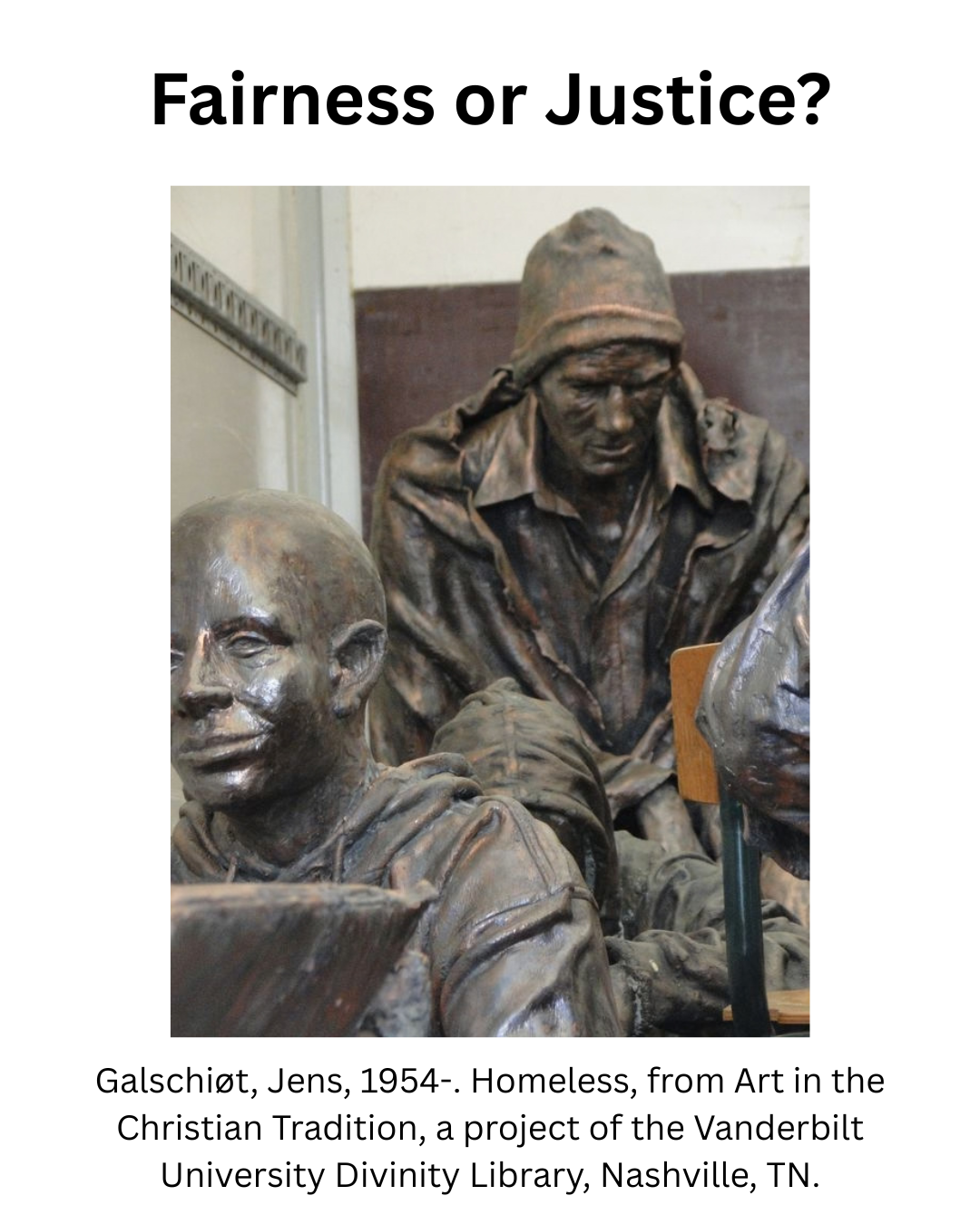
The parable of the vineyard workers has sometimes been allegorized to be about God’s grace in welcoming new members into the household of God. This interpretation often ends up reinforcing negative stereotypes of Jews.1 Sometimes the parable is allegorized with God as the landowner and the payment is getting into heaven. 2 What if we take this parable and keep it in the “real” world?
Just before this parable, Jesus was asked, “Teacher, what good deed must I do to have eternal life?” Jesus’ response was for the person to sell their possessions. Then Jesus told the astonished disciples, “Truly I tell you, it will be hard for a rich person to enter the kingdom of heaven. Again I tell you it is easier for a camel to go through the eye of a needle than for someone who is rich to enter the kingdom of God.” Peter comments that the disciples have “left everything” to follow Jesus.3
Jesus said, “But many who are first will be last, and the last will be first”,4 and then told this parable. That statement brackets the parable.
“For the kingdom of heaven is like a landowner who went out early in the morning to hire laborers for his vineyard. After agreeing with the laborers for a denarius for the day, he sent them into his vineyard. When he went out about nine o’clock, he saw others standing idle in the marketplace, and he said to them, ‘You also go into the vineyard, and I will pay you whatever is right.’ So they went. When he went out again about noon and about three o’clock, he did the same. And about five o’clock he went out and found others standing around, and he said to them, ‘Why are you standing here idle all day?’ They said to him, ‘Because no one has hired us.’ He said to them, ‘You also go into the vineyard.’ When evening came, the owner of the vineyard said to his manager, ‘Call the laborers and give them their pay, beginning with the last and then going to the first.’ When those hired about five o’clock came, each of them received a denarius. Now when the first came, they thought they would receive more; but each of them also received a denarius. And when they received it, they grumbled against the landowner, saying, ‘These last worked only one hour, and you have made them equal to us who have borne the burden of the day and the scorching heat.’ But he replied to one of them, ‘Friend, I am doing you no wrong; did you not agree with me for a denarius? Take what belongs to you and go; I choose to give to this last the same as I give to you. Am I not allowed to do what I choose with what belongs to me? Or are you envious because I am generous?’ So the last will be first, and the first will be last.” Matthew 20:1-16 NRSVue5
What do we discover if we don’t allegorize the parable? Think about the character you most identify with and how that influences how you think about the parable.
Vineyards were not a basic crop for survival. They required investment and the ability to wait until they became productive. They were, also very profitable.6 The landowner was likely a wealthy person, who had the money to invest and the capacity to wait for the return on his investment. There were many day laborers. Often they were people who had lost their land and now needed day work, usually at minimal wages to survive. Consider what their life would have been like. Unpredictable employment meant unpredictable access to food and housing for them and their family.
The landowner hired some people for a denarius which was roughly enough to survive for a day. The landowner went out to the marketplace four more times and hired people for “whatever is right”.
The text says they were “standing idle”. What do you think that meant? Sometimes we equate idleness with laziness, but idle can also mean they were not hired. They were in the marketplace, available to work and either there was no work or they were not hired. Why were they not hired? Perhaps there was no work. Perhaps they were seen as less desirable workers. Perhaps they were older, or sick, or handicapped. Perhaps they were not at the marketplace earlier because they were at another job. Perhaps the five o’clock workers were looking for a second job that day. We don’t know. We should be careful about making assumptions about them.
Finally the work day was over and it was time to pay the workers. This is where the parable gets uncomfortable. The owner paid the last people hired first and they got a denarius. He paid everyone a denarius. What is your reaction to that? In the parable the first people hired complained that the owner had acted unfairly. “These last worked only one hour, and you have made them equal to us who have borne the burden of the day and the scorching heat.”
The owner replied that he paid them what he promised them. If he wants to be generous, that’s not their concern.
The owner by his actions has turned the workers against each other. Notice what they said, “you have made them equal to us…” They are now divided by envy and jealousy. Did the first hired resent the pay of the later hired? Or were they glad about that but thought they deserved more? The owner’s actions caused envy and division among the poor day laborers. Were they so jealous of each other that they forgot about the oppressive system that made them all day laborers?
The owner asserted that he can do what he wants with his money and casts himself as a good person. The phrase translated “Or are you envious because I am generous?” is literally ” Is your eye evil because I am good?” It’s an interesting translation choice. Are “generous” and “good” equivalent? The owner managed to blame the workers for being jealous and presented himself as good and above reproach. All the while he was acting out of his privilege as a wealthy landowner. He could do what he wanted with his wealth. He paid the accepted, minimum wage. If they are unhappy, that’s on them. Was he actually generous or good?
Now we are left with questions. Should a good or generous employer pay more than a substance wage? Do people have a right to a living (not just survival) income? Do social and economic systems divide workers so the rich can hold on to their wealth?
I asked earlier, about which character you most identify with and how that influences your understanding of the parable. Do you identify with the landowner, the business owner? Do you identify with the first hired, who worked long and hard? Do you identify with those who had to wait until someone decided to hire them? Can you try to identify with another character in the parable? What do you discover?
Consider these thoughts from an Instagram post by the “Reverendmamas”7
“Through a migrant’s eyes, this isn’t a story about people getting an unfairly generous bonus. This is a story about people who have spent the day waiting for someone with power to decide whether or not they get to eat. The point: If you’ve spent your life being told that justice means getting what you’ve earned, grace looks like generosity. But if you’ve spent your life wondering whether there will be enough, grace looks a lot like justice.”
The parable doesn’t offer a solution. And neither will I. We need to sit with the discomfort and challenge of this parable. What does a world where “the last will be first and the first will be last” actually look like? How would we do that? What would we gain? What would we give up?
When have we not been generous? When have we been jealous? When have we begrudged others basic necessities? Access to food, health care, adequate housing? Physical and emotional safety?
Jesus didn’t give people food in theory. He didn’t heal in theory. He fed hungry people and healed sick and injured people. He taught and lived a non hierarchical way of life.
Can we? Will we?
- Often the first hired are interpreted to be “the Jews” who would exclude the later hires, who are either Christians or the “impure” or gentiles. See Amy Jill Levine, Short Stories by Jesus, chapter 7 “The Laborers in the Vineyard” for a discussion of this. ↩︎
- Boring, M. Eugene, “The Gospel of Matthew” in The New Interpreter’s Bible Vol VIII, Leander Keck Ed. 1994,Abingdon Press , page 392. ↩︎
- Matthew 19:13-15, 16-22, 23-26, 27-30. We would do well to think about how we find ways to adjust Jesus’ statements so they are not so demanding on us. ↩︎
- Matthew 19:30 ↩︎
- See Carter, Warren, Matthew and the Margins: A Sociopolitical and Religious Reading, Orbis Books 2001, and Boring, M. Eugene, “The Gospel of Matthew” in The New Interpreter’s Bible Vol VIII, Leander Keck Ed. 1994,Abingdon Press for discussions of the text that influenced this post. ↩︎
- Carter, 395 ↩︎
- Cameron Vickery and Victoria Robb Powers, @reverendmamas, ↩︎


Leave a Reply