What does it mean to be a Christian and a citizen? What should or could the relationship be? These are perennially important questions to consider.1
I’m not saying anything new or novel when I say that we live in bewildering, unsettling and polarized times. The emergence of Christian Nationalism as a political force is particularly disturbing.
As citizens and as people of faith, we seem to be talking past each other- when we make the effort to talk to each other. Historians are helping us understand why and how we ended up here.
But what is “here”? Why, especially within American Christianity, do we have such deeply divergent beliefs about what it means to be a Christian and a citizen. In spite of a shared faith, we have very different views of how the world is, how the world should be, and how Christian people are supposed to act in it. A blog post or even a series of blog posts can’t adequately unpack all this. But perhaps we can begin and perhaps we can gain a bit of clarity. One place to begin is to thinking about how we believe the world works. What is or should, the relationship between people be? What should the relationship between the people and their government be? What does faith have to do with any of this?
The current administration and Christian Nationalists and MAGA people view the world through a transactional lens. Life is about “deals”. Money and power are the end goal. When all aspects of life are transactional, the world gets divided into winners and losers. It’s a short step then, into believing people are either “us” and “them”. For us or against us. Friend or enemy.
A transactional worldview, commodifies everything and everyone. Land only has value if it is productive, meaning money can be made off of it. In this worldview, selling or trading part of a national park for a private person to build a road so they can develop a resort, makes sense.2 As does allowing copper mining in the Boundary Waters area.3
A transactional world view means that members of the administration see people basically as workers, units of production for the economy. Mehmet Oz, of the Centers for Medicare & Medicaid Services has advocated for workers to work an additional year before retiring in order to generate more money for the US economy.4 Similarly administration officials and members of Congress want people to earn or at least somehow be deserving of access to health care and food assistance.
He, of course, is not the only person saying such things. Here is a recent article from the Religion News Service about white Christian Nationalist “pastors and influencers.5 Here is just one quote from Joshua Haymes from the article, “It is not inherently evil to own another human being, he said about slavery in a late December episode on his Reformation Red Pill YouTube channel, adding that “it is very important that every Christian affirm what I just said.” People can be commodities in this view, and often these “influencers” use the Bible to justify the commodification of other humans.
There is almost an endless supply of similar comments and statements by members of the administration and white Christian Nationalists.
Salvation, for some Christians, is reduced to a transaction. ‘Jesus paid the price’ and similar statements serve to reduce the mystery and grace and the depth of salvation to a transaction.
Once you see it, the transactional world view is easy to spot. It is a common assumption. It is easy to adopt the transactional world view. It is the air we breathe. It is so pervasive, we may struggle with what the alternative view is.
Diana Butler Bass, on the podcast “The Convocation Unscripted” shared this conversation she had with a Rabbi friend over lunch. 6Her Rabbi friend got to the heart of the matter.
“He said, ‘Nationalisms are always and authoritarianism is always about transactionalism.’ And he looked across the table and he said, ‘For you and me, Diana, we live in a world that isn’t guided by transaction, but is guided by covenants.’ The primary covenant being the covenant of loving God and loving your neighbor as yourself.”
Covenant. The idea of covenant is deeply biblical. For example, there is God’s covenant with Noah. And with Abraham. And with the people of Israel. And for Christians, the new covenant of Jesus.
What is interesting about covenants is that while both parties of the covenant have obligations, a covenant also binds the parties together. In the Bible, covenants, especially the Sinai covenant isn’t conditional, it remains in effect even if one party “breaks” it. In the transactional world view contracts can be broken, and deals can be abandoned.
Covenants bind us together in a mutual relationship. Covenants are not about one party winning. They are about both parties being committed to each other. The covenant at Sinai binds the people of Israel to God, and, importantly, it binds them to each other. They have responsibilities to God but these responsibilities also include how they live together in a just society. Torah is how the covenant is worked out in daily life- for individuals and for the nation. And Torah is extremely concerned with how people treat each other and how people care for each other- as individuals and as a nation.
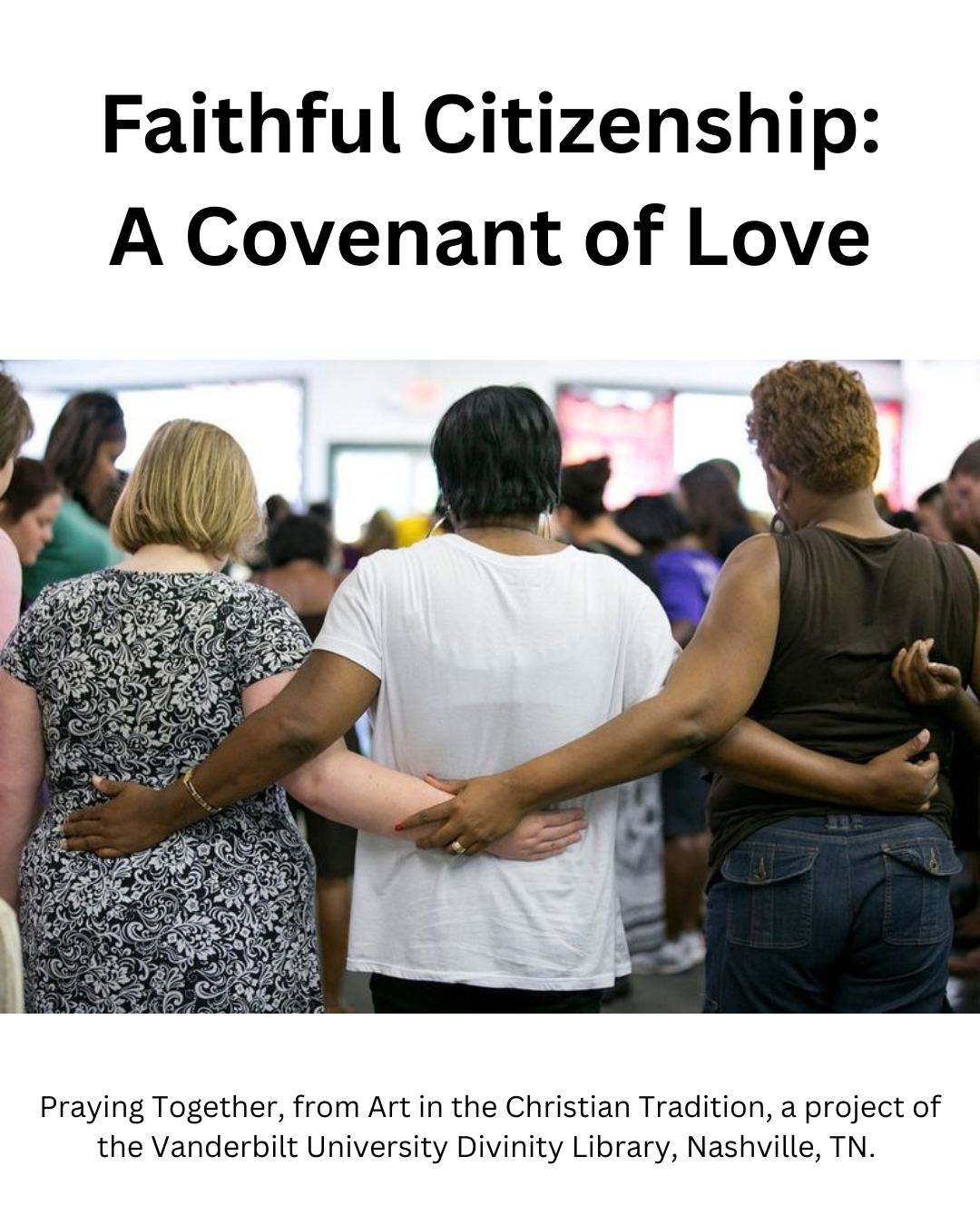
Jesus doesn’t say much about covenants until the Last Supper. But his whole life and teaching is based in covenant. Jesus calls us to become part of a covenant of love. Jesus taught his disciples the importance of caring for each other. Healing the sick. Feeding the hungry. Challenging unjust systems in creative, non violent, and loving ways. Jesus calls us to not be afraid of those who are in some way different from us. Think about the Sermon on the Mount. Think about the parables. Think about Jesus’ last instructions to Peter, “Do you love me?” “Feed my lambs.” “Take care of my sheep.”7
How, then, do we as Christians who are citizens live guided by covenant? There are certainly personal acts of care and support that we do. But living with a covenant worldview affects how we vote and what we encourage our legislators to do. Living a covenant of love means loving our neighbor. Living a covenant of love also means loving our enemies. Living a covenant of love means working for (and voting for) the well being, the flourishing of everyone.
Living a covenant of love may mean we vote and advocate for what makes the lives of others better, even if it doesn’t directly improve our lives.
Living a covenant of love means we think about the well-being of others before we think about our own well being in the laws and policies we advocate for.
Living a covenant of love means we guard the dignity and well being of all. It means everyone is included and cared for. It means our guiding orientation a citizens is love.
This is an immense shift from where we are today. It is an immense reorientation of how we act as citizens and as a nation. We have so far to go that it is easy to be frustrated and angry.
In the podcast, Diana Butler Bass said,”I feel that when we get most angry, it’s really a cry from our hearts for urgency of love to come forth and that people could really experience and know what it means to live in a community that is covenanted around bread and wine, a covenant that’s covenanted around tables, a covenant that is is is written in love.”
Midterm elections are coming soon. It behoves us to think about what it means to be a Christian and a citizen. It behoves us to think about what a covenant of love looks like in our nation.
- Because I am a US citizen and a Christian, this post will focus on Christianity and United States. To write about other faiths or other countries would be irresponsible of me. ↩︎
- https://www.theguardian.com/us-news/2026/aug/28/yosemite-national-park-private-developer ↩︎
- https://www.savetheboundarywaters.org/ ↩︎
- https://www.investopedia.com/dr-oz-wants-americans-to-work-1-year-longer-to-boost-the-economy-but-is-it-realistic-11937737 ↩︎
- https://religionnews.com/2026/09/24/the-rise-of-the-jim-crow-theobros/ ↩︎
- Diana Butler Bass, Convocation Unscripted, Where are the Conservative Patriots? Sept 18, 2026 @55.35 ↩︎
- John 21:15-18 ↩︎


Leave a comment